Index Funds and Government Bonds Are All You Need for Investing

No video for this article
Contents
"People say you need to invest, but what should I actually do?" All sorts of people say "The Nasdaq is the way to go" or "No, right now it's the Nikkei average (Japan's main stock index)." I think many people aren't even that interested in the first place.
I started investing just before the COVID crash in 2020, and lived through the sharp drop and the rise that followed, along with the shifts in market sentiment along the way. I've also made all kinds of trades, which I wrote about in an earlier post.

In this post, I'll lay out my current thinking after all that, framed as what I'd recommend if someone asked me. Plenty of other people have written up the finer details, so I'll leave those out here.
The conclusion
Money I'll leave for a long time goes into index funds, money I'll use within a few years goes into Japanese government bonds for individual investors or an ordinary savings account, and I don't touch anything else.
To begin with, I think your own human capital, and saving on taxes and expenses, matter more than financial assets. That's because they reliably give a bigger return. I've written about that in another post, so here I'll cover only financial assets.
First, I'll address whether you need to invest at all. Next, I'll split money into long-term money and money you'll use within a few years, and say where to put each. After that, I'll cover what I don't touch, and in particular why I avoid real estate.
Don't bet everything on the Japanese yen

First, is investing necessary at all? If you just collect your salary and do nothing, you're betting all your assets on the Japanese yen. It's less risky than putting your entire fortune into Bitcoin, but it's the same in that you're going all in on one thing.

Another thing that's easy to overlook is the salary you haven't received yet. For young people especially, it comes to hundreds of millions of yen.
There's nothing you can do about this; it's locked into Japanese yen. Since that portion is already entirely in yen, I think it's better to move the money you have on hand elsewhere early on.

You can see why going all in is a bad idea by comparing with the dollar, for example. Five years ago, in 2021, one dollar was about ¥110; in October 2026 it's about ¥158. Measured in dollars, the yen has lost about 30% of its value.
Your future salary, too, has in effect already shrunk by about 30% when measured in dollars.
Index funds for the long term
So where should long-term money go?
I think some kind of index fund is fine.
I think a long-term home for money should meet these three conditions:
-
You can buy at regular intervals and leave it alone
-
You don't have to change your decision even when circumstances change
-
Its expected long-term return is high
What meets them is a low-fee global index fund.
Which global fund you choose is honestly more or less a matter of taste, so I think you can pick whatever you like.
The reason I don't go with just the US or just Japan is that a particular country's growth can stall, as Japan's did in the past. If you've bet on that country, you'd have to change your decision, which is a hassle. So I go global from the start.
As long as it's well diversified and you can keep it up for a long time, the expected return doesn't change much, whether it's high-dividend or anything else. There are minor differences, like taxes being a bit different depending on whether it's a high-dividend fund, but while your assets are small, they don't add up to much.

For what it's worth, I keep half in a global stock fund (the popular all-country fund nicknamed "Orukan" in Japan) and the other half in a high-dividend fund.
I hold Orukan because it's easy on the mind. When most people own Orukan, if it alone goes up while my own fund does poorly, that becomes a source of stress.
The other half, the high-dividend fund, is simply my preference.
What about NISA and iDeCo?
For NISA (Japan's tax-free investment account), I think it's best to fill your allowance with funds that don't pay out distributions, like a global stock fund. With a high-dividend fund, the distributions you receive leave the tax-free allowance, which reduces the amount that can keep growing inside it over the long term.
A high-dividend fund that doesn't pay out distributions won't leave the allowance, but then there's little point in going high-dividend.

With iDeCo (Japan's private pension plan with tax benefits), your contributions are deductible from your income, and at a doctor's tax rate, you save around 40% of them. However, you can't withdraw the money until age 60.
You'll have a pension as well, and there's not much point in having more money than you can use up in old age. If there's something you want to do, I think it's fine to prioritize that.

Money for the next few years goes in government bonds or savings

Next is money you'll definitely need in a few years. I put this in Japanese government bonds for individual investors or an ordinary savings account.
The good thing about these bonds is that they're nearly risk-free. Once a year has passed since issue, you get back the face value, minus only an amount equal to the previous year's interest.
The 10-year floating-rate bond pays 2.05% a year for the October 2026 issue. The rate is reviewed automatically, so it's ideal for leaving alone.
If you know when you'll use the money, say in five years, the 5-year fixed-rate bond is fine too (2.39% a year in the same month's issue).
Apart from how the 10-year floating rate moves, everything can be calculated in advance, so you can just pick whichever comes out best.
If that's too much bother, simply leaving the money in an ordinary savings account is fine too. Even Japan's megabanks will pay about 0.5% a year starting November 2026.
The difference from the 5-year fixed-rate bond (2.39% a year) is about 1.5% a year after tax. On ¥1 million, that's about ¥15,000 a year, so if you're fine giving that up, I don't think you need to bother.
Avoid things that take a lot of effort

Next are the things I don't touch.
REITs (real estate investment trusts), individual stocks, and corporate bonds have high expected returns, but I basically don't think there's any need to get into them.
The reason is that they take a lot of effort.
A REIT is a bundle of real estate properties, and its appeal is the relatively large dividends. But there are many types, such as residential, retail, office, and hotel, and you have to analyze what's inside each one.

The amount of effort is similar for all of them, individual stocks and corporate bonds included. You need to look into all sorts of details, such as the actual financial condition.
I described part of how I analyze individual stocks in the earlier post. But if you're going to hold them for a long time, there's more to look into, like future prospects, management's thinking, and the company's position in its industry.

On top of that, it's not a one-time thing; you have to keep analyzing regularly, and honestly it's quite hard work. As I wrote in the earlier post, that effort isn't worth it, so I don't really recommend it.
Precious metals and crypto assets are a separate category. They're interesting, but I wouldn't recommend them to everyone.
Stay away from real estate

Finally, I stay away from real estate. There are two reasons.
The extra return is thin

Let me do a rough calculation using numbers that favor real estate. Say you buy a desirable property, such as one near a station, with a 20% down payment and a 35-year loan at 2.5% interest.
| Item | Amount |
|---|---|
| Property price | ¥48 million |
| Down payment | ¥9.6 million (20% of the property price) |
| Closing costs | ¥3.5 million (about 7% of the property price) |
| Loan | ¥38.4 million (2.5% interest, 35 years) |
| Rent | ¥2.4 million a year (¥200,000 a month, 5% gross yield) |
| Management fees, etc. | ¥480,000 a year (1% of the property price) |
| Loan repayments | ¥1.65 million a year (year 1: ¥950,000 interest, ¥700,000 principal) |
| Cash left over | ¥270,000 a year (rent − management fees, etc. − repayments) |
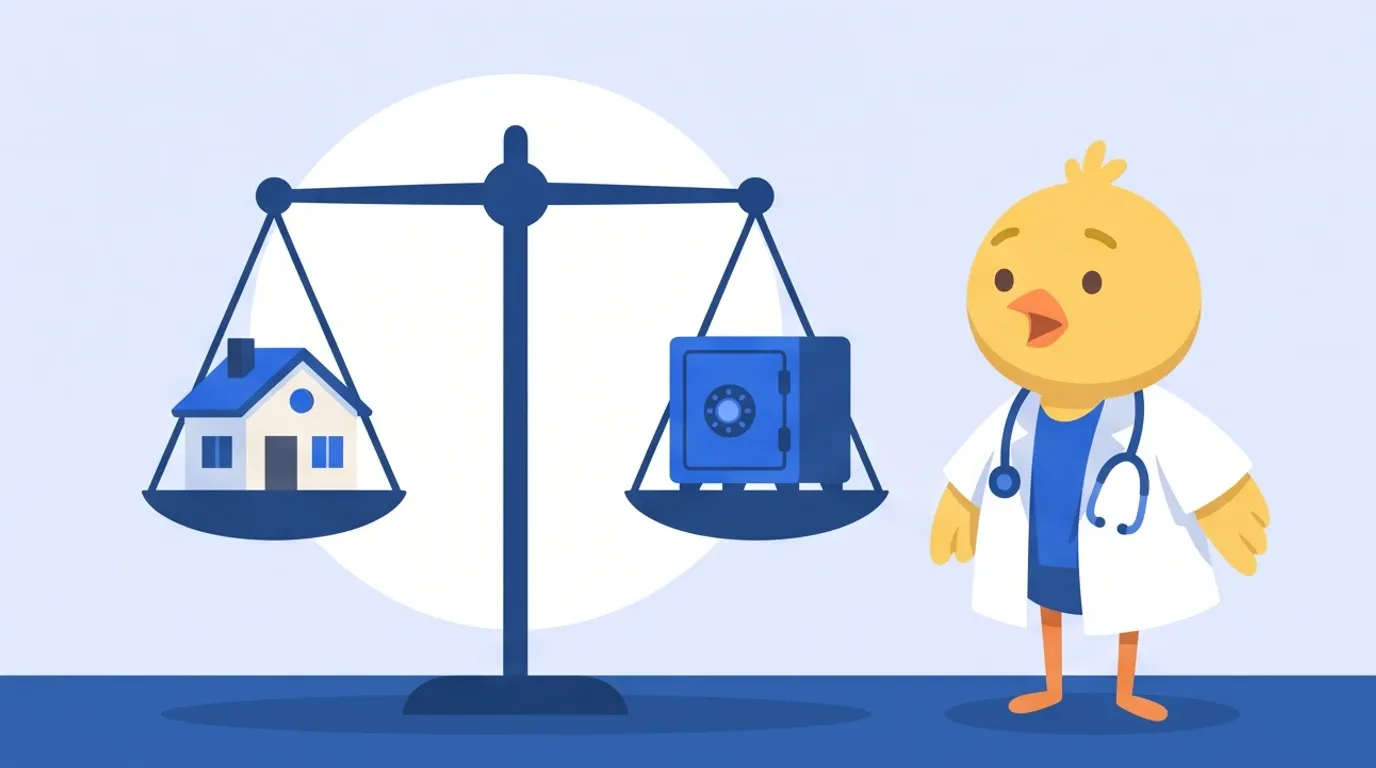
If you instead put the ¥13.1 million for the down payment and closing costs into Japanese government bonds for individual investors (2.05% a year), you'd also get about ¥270,000 a year. The cash left over is almost the same.
The difference is that after 35 years, you're left holding an old property. And this is a favorable estimate too; properties near stations in good condition hardly ever come up for sale in the first place.
The risk is too large
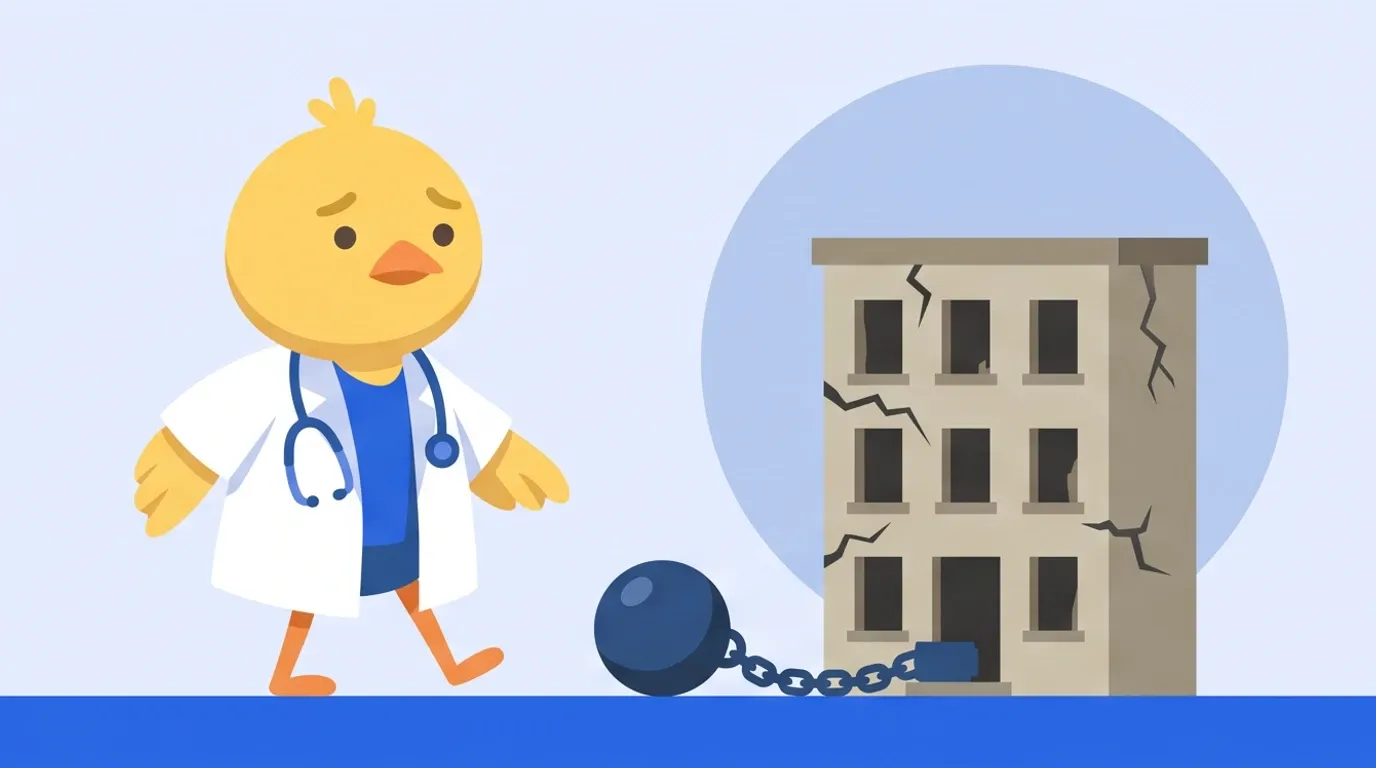
What you take on for that old property is ¥38.4 million in debt. If the interest rate rises to around 3.6%, the cash left over turns negative. If the property's price drops by 10%, ¥4.8 million disappears.
With tens of millions of yen in debt on your back, you lose your freedom when you want to open your own practice someday or do something else.
There are also risks like not finding tenants, discovering shoddy construction, or facing rebuilding costs decades from now. There are also lots of smaller matters, such as taxes. Do you really have a handle on all of that?

There's also the tax-saving angle: running a loss on the property to lower your taxable income. But if you can't work out the tax calculations precisely yourself, you can't even tell whether it really pays off. When I consider whether the amount you'd gain is worth the risk and the time spent studying, I don't recommend it.
Don't spend time on investing

To sum up, every approach I recommend is one that doesn't take up your time.
Index funds and government bonds alike can be left alone once you've decided.
I basically don't touch things that require a lot of research or leave you at the mercy of debt.

Even if you were extremely skilled and could consistently beat the market by 1%, with total assets of ¥100 million that would be ¥1 million at most. In that case, wouldn't it be more efficient to simply work as a doctor?
So once you've decided where to put the money you earn from side shifts, leaving it alone is enough. Please use the time you free up for your work as a doctor and for the things you want to do.