How Many Days a Week Does a Doctor Need to Work? Calculating Living Costs and Savings Rate When You're Not Aiming for FIRE

No video for this article
Contents
"What am I saving money for in the first place?"
It's a question that suddenly comes to mind when the anxiety doesn't go away no matter how much you save.
I'm a freelance doctor, and I could work as much as I wanted. When that's the case, my days off disappear before I notice.
I felt I needed to set a target for how much is enough to earn each month, and I've given it a lot of thought.

In this article, I'll describe how I estimate and set that target amount.
Conclusion
How much you need to earn each month depends on how much of what you earn you save (your savings rate) and how long you intend to keep working. Once you know how much is enough, you can estimate from your hourly rate how many hours you need to work.
In my case, it's about two days a week, and I decide freely how to use the rest of my time. In the end I'm often working anyway, but it feels like free time.
Here's how this article goes:
-
Estimate your current living costs, spreading big purchases into monthly amounts
-
Use the 4% rule and your savings rate to see when you could live without working
-
What earning power is worth, and my own savings rate
-
How to use the rest of your time
Estimating Your Current Living Costs

First, estimate how much you need each month to keep up your current life.
If you check your household budget book or credit card statements, you'll get a rough idea of expenses that change from month to month, like food.
To this, add fixed costs, such as rent, that are withdrawn directly rather than paid by credit card.

Don't forget to include health insurance premiums and pension contributions as well. If you're a company employee, they're deducted from your paycheck, so they're easy to leave out, but they're money you're actually paying.
Spread Big Purchases into Monthly Amounts

What I'd also recommend is adding in big purchases, spread out into monthly amounts.
For example, say you bought the smartphone you're holding right now for ¥150,000.
If you use it for five years, that's ¥30,000 a year, the same as a ¥2,500-a-month subscription. Thinking this way, you can fold one-off purchases into your monthly living costs.

In the same way, look around your home and work out the things that cost a fair amount when you bought them. You can ignore small items; the big ones alone are enough.
For example, a refrigerator bought for ¥100,000 and used for five years comes to ¥1,700 a month. A ¥200,000 front-loading washer-dryer used for seven years comes to ¥2,400 a month.
Line Them Up from Largest to Smallest

I manage my own household finances this way. When I line up my monthly expenses from largest to smallest, number one is rent, at ¥80,000.
Second, surprisingly, is the move-in costs for my home. It's money paid in a lump sum when you move in, but partly because I moved out sooner than I expected, spread monthly it comes to ¥42,000, about half my rent.
After that come health insurance premiums at ¥30,000, AI costs at ¥20,000, and then pension contributions.

Other things near the top are my laptop, at about ¥5,000 a month, and my dishwasher.
The dishwasher itself is ¥1,000 a month, but the installation I paid for when I moved comes to ¥3,500 a month, more than three times the cost of the unit itself.
It shows that moving after a short time hits the household budget harder than you'd expect.

I don't own one now, but a car is also a big expense. In the past, even with tricks like taking it to a cheap shop for its mandatory inspection, a single kei car (Japan's small light-vehicle class) cost me about ¥30,000 a month.

Spreading things out monthly also lets you compare them with subscriptions. A ¥3,000-a-month phone bill is about the same as the smartphone spread out monthly (¥2,500 a month) or the washer-dryer (¥2,400 a month).
You can see on the same scale that phone bills are surprisingly big.

Estimating this way tells you the minimum amount you need to earn to keep up your current life. In my case, it's about ¥300,000 a month, including health insurance premiums and pension contributions.
Incidentally, I haven't included taxes, since they rise and fall with how much you earn.
Looking at the Surplus with the 4% Rule

Next is whatever you earn beyond your living costs. For example, if your take-home pay is ¥500,000 a month and your living costs are ¥300,000, you have ¥200,000 left over each month.
The 4% rule is useful for looking at this surplus. It's a rule of thumb from studies of past markets: withdrawing up to 4% a year from your savings was unlikely to run them dry.
If you're putting aside ¥200,000 a month, then for every year you work, the amount you could withdraw each month without working grows by about ¥8,000.

Since you invest what you save, it also grows by the investment returns. Here, to match the 4% rule, I'll keep it simple and assume returns of 4% a year as well.
Your Savings Rate Determines the Number of Years

The share of your take-home pay that you set aside as savings is called your savings rate. If you save ¥200,000 out of ¥500,000 in take-home pay, your savings rate is 40%.
In that case, your living costs are 60% of your take-home pay, so to cover them with 4% withdrawals, you need assets worth 15 times your annual take-home pay. If returns are also 4% a year, the number of years it takes to get there is determined by the savings rate alone.
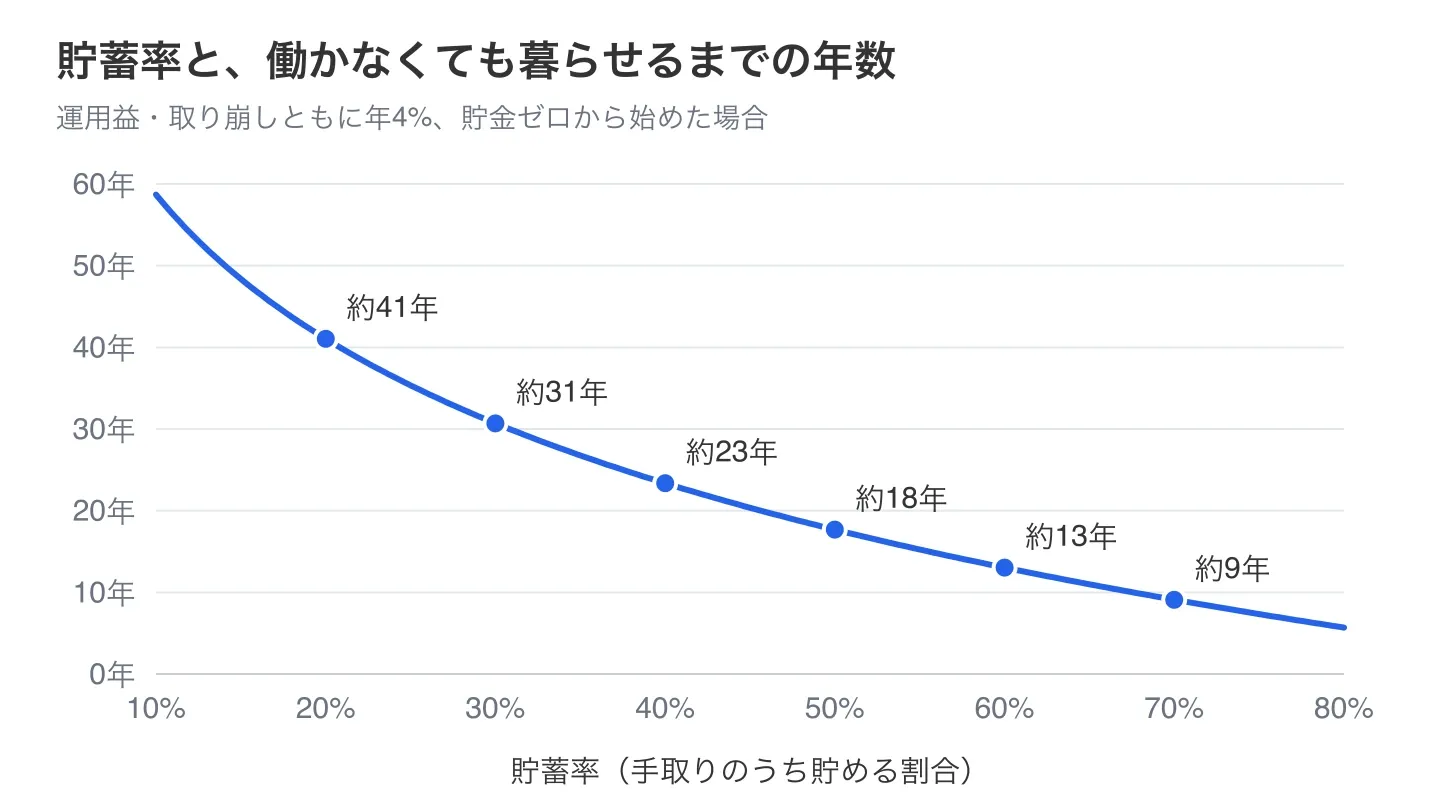
At a 40% savings rate, it's a little over 20 years. Actual returns could quite possibly exceed 4%, so I think that leaves some margin even after accounting for inflation and taxes.
This graph can also be read in reverse. Decide how many more years you'll work, and you'll know the savings rate you need.

For example, if you want to stop working completely in 10 years, you'll need a savings rate of about 70%. That means you can only spend about 30% of what you earn.
On the other hand, if you keep working at a moderate pace until 60 or 70 and you're in your 30s now, you have 30 to 40 years. In that case, a savings rate of 20–30% is enough. Take a moment to think about what savings rate you need.
I've written about where to keep your savings in a separate article.

Add Future Expenses on Top

In reality, beyond simply keeping up your current life, you'll also need money for things like your children's education and retirement.
For example, if you need ¥10 million within 20 years, simply dividing it out comes to about ¥42,000 a month. In practice I assume you'll invest it, so it comes out a little lower.
If you add this on top of your living costs, future expenses are built into your estimate.
Earning Power Is Your Biggest Asset

The 4% rule can also be used in reverse: to see how much in assets a given monthly earning power is equivalent to.
Assets that let you withdraw ¥33,000 a month at 4% a year come to ¥10 million. In other words, the ability to earn ¥33,000 a month is worth the same as ¥10 million in assets.
If your take-home pay is ¥500,000 a month, that's equivalent to ¥150 million in assets.

In the same way, you can put a value on cost-cutting that lasts indefinitely. Keeping up ¥33,000 a month in cost-cutting is the same as owning ¥10 million in assets.
So, especially while your financial assets are still small, looking after the health that protects your earning power, and tax savings and cost-cutting that keep paying off indefinitely, are worth doing before investing.


My Savings Rate Is About 40%

For my part, I think I'll keep working one way or another, and I'm not aiming to stop working completely. So I don't think I need to rush to save.
That said, I may have big expenses in the future, so I'm saving for those. On top of ¥300,000 in living costs, I aim for about ¥200,000 a month, which is a savings rate of about 40%.
It's a benchmark at which I think I'll be fine even if a few big expenses come along the way.

So how much do you need to earn to reach that savings rate? If you're in a full-time position, divide the pay on your pay slip by your working hours to estimate your hourly rate. If you do one-off locum shifts, simply add up the jobs.
In my case, it comes to ¥500,000 a month all together, so at ¥10,000 an hour that's 50 hours a month, or two days a week even after factoring in taxes. That's enough work, even including the money I'll need in the future.

The only ways to change your savings rate are to earn more or spend less. I think you can just consider which is easier for you to control. For doctors, the hourly rate doesn't change much depending on your specialty, so it simply comes down to whether you work more hours.
Using the Rest for What You Want to Do

To sum up so far: estimate your living costs on a monthly basis and decide on your savings rate and how long you'll work, and your working hours follow from your hourly rate. Whether to work more than that is up to you.
So what do you use the rest of your time for?

My biggest purpose in life is to be able to say "It was a good life" at the moment I die, including both the fun and the hard parts.
Money is just a tool for that. So once I've earned enough, I spend the rest of my time on that.

I think the answer to "What am I saving money for?" lies not in the money calculations but in how you use the rest of your time.
I've written about what I've used mine for so far in the following articles.